Tag Archives: Jewish

South of Sepharad- A Review

Standard

This book will be released on February 20, 2024- Mark that date on your calendar as you are going to want this one. Many thanks to History Through Fiction for the pre-release copy in exchange for an unbiased review.

When most of us initially think of 1492 and Queen Isabella and King Ferdinand of Spain, we think of Christopher Columbus and his journey to the new world (which is a whole other problematic tale). We might also think about their daughter Katherine of Aragon who married two Tudor princes. What we might not think about is the edict this king and queen sent out in 1492 to require all the Jewish citizens of Spain to leave the country or convert to Catholicism. Under penalty of death.

The story of Vidal and his family, South of Sepharad, by Eric Z. Weintraub, takes us past these better known happenings affecting Spain in 1492 to something sinister and evil. The expulsion of a whole population of people from the country of Spain.

I had heard of the horror of the Inquisition, of course, and seen films and read other books about it. This story from Mr. Weintraub was so well-written and had characters so vividly drawn that the absolutely horrific events were brought home in a way that, while hard to read, made the journey of these Jewish people who had to leave with what few possession they could haul on a wagon really hit hard. They didn’t do anything wrong to warrant expulsion except practice their religion.

I’ve always been shocked and saddened at the number of deaths and amount of torture inflicted on others in the name of God. And this story didn’t shy away from the Inquisition and what those so-called holy men were capable of. If they wanted you dead, they would plant words in the mouths of the person they were interrogating. They would also twist what the person said to match their own agenda.

This book hit all the harrowing parts of the journey out of Spain for the Jewish people. From having to sell homes that had been in their families for generations, and selling their possessions and heirlooms, to leaving people behind, and the way their feet hurt and boots became full of holes on that journey. It also covered the food shortages and lack of water. I felt as if I was on the journey with them.

Even the few who stayed behind and converted to Catholicism weren’t really safe as they were always suspected of converting for purposes that weren’t sincere. And it was a forced conversion so how sincere could it have been? To betray the religion of your people must have been very difficult to decide to do. In short, these poor people were in a no win situation.

This book is an important one for us to read in these times. This horror of disliking or even hating people of other religions seems to have never gone away, but it seems to be coming back to the forefront of being acceptable to treat those who do not share certain beliefs as less than human.

The story in this book is obviously fiction and it’s well told. The author has a beautiful way with prose. Even though it’s hard to read in places, it’s an important and captivating tale (with moments of heartbreak) of one family’s life and the changes they are forced to make by a king and queen who were absolutely vile human beings.

The author did meticulous research and immersed us in the world of Spain in 1492. He gives some excellent resources at the end as well. The cover is so vivid and attractive too.

I give this one five stars
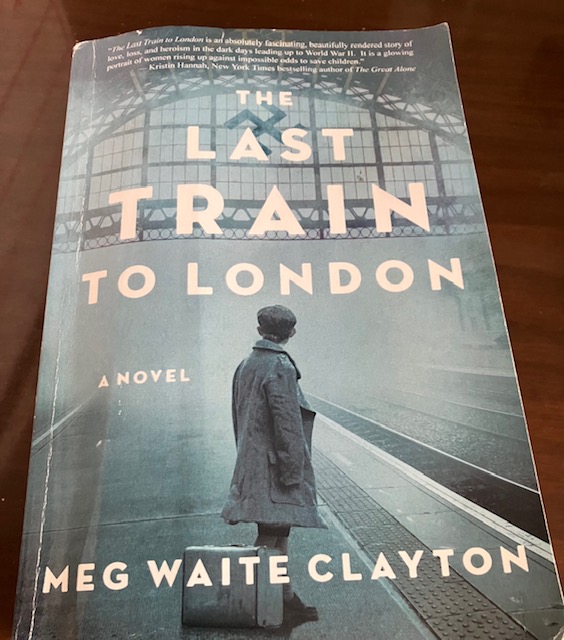
Review – Last Train to London by Meg Waite Clayton

Standard

This is a fictionalized story based on the very real kindertransport trains and ferries taking Jewish children out of Nazi Europe. The real woman who convinced Eichmann to allow the first 600 children to be transported to London, when England agreed to provide visas for them, was named Geertruida Wijsmuller. She saved a large number of Jewish children’s lives, first by taking two and three, and sometimes as many as ten, out of Germany and into the Netherlands. She started doing this in the mid-1930s. The situation became more urgent after Hitler invaded Austria. Many countries closed their borders and refused to allow Jewish people entry visas. Tante Truus, as she had the children call her, worked with some highly placed people in England to pressure their parliament to allow children to be evacuated and held in two summer camps until foster families could take them in. After the war, she was granted Righteous Among the Nations status.

The story in this book centers on two families. One a wealthy Jewish chocolatier who has a wife suffering from cancer. They have two sons, Stephan and Walter. The other, a barber, a Christian grandfather who has a widowed daughter-in-law with two daughters. One is Zofie-Helene and the other Johanna. Their mother is a journalist who is very outspoken against the Nazis.

The story starts with both families living their normal lives and Zofie and Stephan becoming close friends. She’s mathematically gifted and he’s interested in being a playwright.

The chapters alternate between their stories and the story of Tante Truus and her rescues of small groups of children and the dangers she faces in that endeavor.

With Truus in the Netherlands and the others in Vienna, I wondered in the early parts of the book how she was going to help them being as they are quite a ways apart.

When Germany annexes Austria with not so much as a shot fired and seemingly overnight, Stephan’s family’s life undergoes a massive change. His father is taken to a camp and he goes into hiding as he is of an age where the Nazis want to inter him in a camp as well. His brother is only five and, at this time, they were not taking children that young to the camps.

Zofie’s mother, a Christian, eventually gets taken by the Nazis due to her unwelcome stories pointing out their conduct which she won’t stop writing even though she is pressured to do so. The two girls are left with their grandfather.

The story unfolded at a good pace. Some of the parts were very hard to read. The author depicted the utterly senseless cruelty of the Nazis and their adherents very well. It always amazes me how terribly awful these people could be to other people. And how the population turned on people who had been their friends and fellow citizens just days prior.

The author also did a good job showing the fear and terror of the ordinary citizen and why so many didn’t speak up to try to stop the atrocities they witnessed. A great part of the population was cowed and if they spoke up, they would be punished severely as well. Some of them tortured and murdered merely for voicing an opinion—or for nothing at all, even an imagined slight.

It was a harrowing read but one I recommend for several reasons. One, the story of the main characters in Vienna seems to be a reflection of what a lot of families went through during this time. Two, the story of Geertruida Wijsmuller is a story of how one person can make a massive difference in the lives of so many. One voice, one brave soul, she saved so many and gave them a chance at life and that is amazing. And third, with the seeming resurgence of some of the awful ideas the Nazi’s had, this is an important read. We must never, ever, let these things happen again and the author of this book makes what happened to Jewish people, as well as anyone who disagreed with the Nazi ideals in that time, all very real and relatable with the characters she created.

This one is well worth a read.