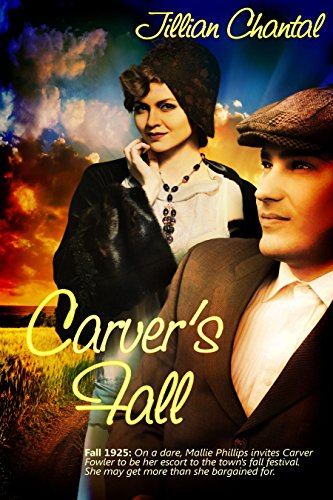
This is a fall short story by Jillian Chantal. She was lucky enough to know a lot of her grandparents and great grandparents due to the longevity gene.
Her paternal great grandfather was Carver Fowler and he was a quiet man who loved to do wood-working. He also, as a young man, had a Model T and spent the whole rest of his life regretting selling it. Jillian always loved that his name was Carver and he did wood-working.
Mallie Phillips was her great grandmother and that lady was a pistol. She was sassy and fun and up until the week before she died, she would be in her yard with her cane in one hand and a rake in the other.
The year of the story is fudged as they would have been older than Jillian wanted them to be in the story if she used their real dates of birth.
Enjoy this free short story– just long enough to read while you have your pedicure. GET IT LINK
Blurb:
In 1924, Carver Fowler, a young man raised on his family’s farm in North Alabama, has long been in love with one of the girls who lives in town. Her name is Mallie Phillips. Mallie has always treated Carver as beneath her notice since in her opinion he’s nothing but a country yokel.
The county’s fall festival is soon and, as a joke, Mallie is dared by a friend to ask Carver to be her date to the party. Mallie takes her up on the dare and visits Carver to invite him to accompany her to the festivities.
In the midst of all the intrigue about whether Carver will be her date or not, a young man is killed and another is attacked. Carver becomes a suspect and Mallie begins to understand that Carver may not merely be the backwoods boy she thought he was.
I picked this one up at the thrift store when I traveled to visit my son and his family. I like to check out thrift and Goodwill stores when I go places to pick up books for my Little Free Library. A lot of times, I don’t read the ones I buy but this one drew me on with the promise of being fun.
And it definitely was a fun read. The protagonist is a perfectionist who loses her job basically through sabotage but, as a reader, you get a feeling of relief that she’s getting off the treadmill that was her life working out of town all week and spending weekends at home. Her family life clearly suffered due to her lifestyle/work absences.
The reader gets to see great character arcs of several of the members of her family.
The daughter is a soccer player and most of the book revolves around her quest to play for an elite travel team. The best parts of the story are where the obsessive coach of the elite team sends crazy, ridiculous memos to the girls and their families every day. He’s loony tunes and never met an exclamation mark he didn’t like.
I spent a lot of the story laughing at his memos and hoping he’d get his comeuppance.
I’m a huge soccer nut so this book was right up my alley. The character growth was well done on the characters who had a chance to change. Not so much on the coach guy, but that was sort of expected. Lol
This book was published in 2008 but it could have come out last week as it was so up to date—other than the reference to the Larry King show.
This was a quick read—less than a day—but full of good, entertaining writing as well as a great message about life’s priorities.
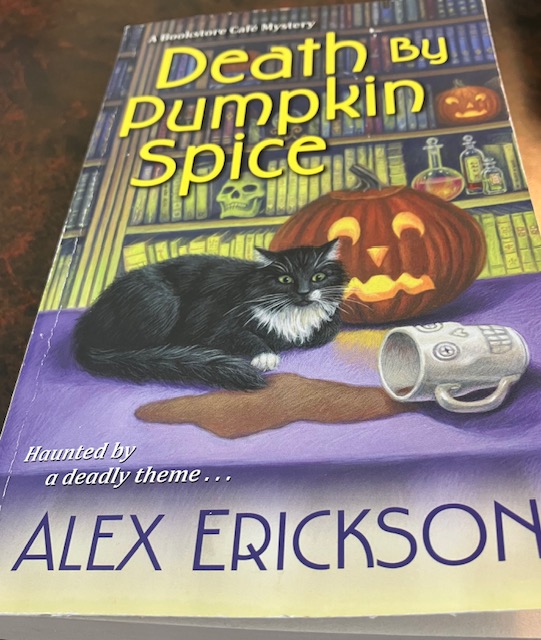
This book is part of a series of stories with the protagonist being the owner of a coffee shop who can’t help but get involved in murders that happen in her town. She’s attracted to the detective she works with on the cases but she also has a date with a local doctor and has a former live in lover who is a stalker. In other words, she attracts drama. And she isn’t very likable.
Even though she owns a coffee shop and the title of the book makes one think there will be some kind of pumpkin spice drink—latte, coffee or even chai—nope. Not any in sight for the entire book.
A woman is killed at a Halloween party and busted pumpkins are all around her but no spices. Nope. None.
The protagonist is smart and clever in the way she can solve crimes but she is one of those types who don’t listen. Even when she is told to stay out of the crime scene, she goes willy-nilly in the room and starts touching stuff.
The first couple of times she didn’t listen were cute but then it got old. I get that the amateur sleuth needs to have access to try to solve the case in these kinds of books, but it really became annoying to this reader. I’m sure there were other ways to get around that issue but her just blatantly ignoring warning after warning became tedious. She went rogue way too many times to count.
All that being said, the mystery itself was good. It was clever to have the story take place at a Halloween party with a terrible storm so everyone was stranded there and also in costume. It heightened the danger and intrigue to make the killer not be able to escape. The other partygoers didn’t seem too concerned to be locked in a mansion with many rooms for a murderer to hide in, though.
I thought the ending was appropriate and I enjoyed the mystery of the murder.
Even though this is a series, I was able to follow the story and figure out who was who without much effort.
For a quick, easy, seasonal read with not much depth, this was a fun one. Just don’t expect any pumpkin spice.
Vianna Roots is a reluctant witch from a Salem family with a long history of witchcraft. She also sees the dead which is not a normal characteristic of a witch. She never fit in—either with the town or her family and had a bad relationship with her mother. As soon as she was able, she escaped in the middle of the night and had no intention of ever returning to her childhood home.
Fate had other plans for Vianna. Her mother died and she had to return home to take part in the ritual of the burial of her mother. But Vianna has other plans than performing the ritual as it is supposed to go. She wants to tie her mother to the grave so she can’t come back and harass her like her other dead relatives do—especially her grandmother Susannah.
When Vianna arrives in Salem, she has an accident in her old truck with, of all things, a local policeman. Then, when she gets to the house she inherited and can’t wait to sell off, the house won’t let her in and things continue to go downhill for her from there.
She doesn’t want to wear witch robes to the cemetery and chooses a red dress from her mother’s closet which turns out to be the dress her mother wore when she was initiated into her role as a witch. Something Vianna is determined not to let happen to herself.
At the cemetery, we meet a number of other characters who all have distinct personalities and who do not much care for the rebel Vianna. The scene is set for more drama in her life.
Vianna ties her mother to her grave and once she returns home, she starts to clear out some of the old things lying around. In searching a drawer, she finds a rotting hand. A vision of a woman reliving her death in the bathroom shows her where the hand originated. And now Vianna is on a quest to help this spirit to rest—a spirit she happens to know quite well. But she doesn’t plan to embrace her legacy as a witch. She is going to solve this issue with this spirit and sell the house and leave again as soon as she can.
Along the way to her goal, Vianna goes on a date with a man she had a crush on in high school. She finds, not only is he weird and possessive, but his mother has issues, too. He’s persistent and annoying. She’s mystified about why he’s suddenly attracted to her. Old school mates wreak havoc in her life, and, when danger arises, she even has to head back to the cemetery to dig up another ancestor and get a bone from her—not because she wants to embrace her legacy, but because it’s necessary to do so.
The cemetery caretaker is someone she knew in the past who is not welcome in the witching community either and they strike up a friendship. I loved their relationship. It was nice to have someone that the heroine could rely on and who was a great character. She offered some relief from the gloomy atmosphere and danger the heroine was in.
This book was delightful to read. A lot of great action, a mystery about some paintings and a dead girl in the bathroom as well as the friendship that arises between two people who don’t fit in makes for a great story. The author also gives us fans of the macabre and light horror a lot of great, descriptive scenes. This is no white witch, light comedy type story that glosses over some of the darker sides of the craft. I quite enjoyed the change of pace from those type stories.
I recommend this one as it is chockful of great scenes, some humor and a compelling story, not least of which is how misfits can find their place and make the home/family they need.
This was a great book with a lot of interesting analysis of Russian short stories and their writers. The author is a professor at Syracuse University and now I want to take one of his classes. While I didn’t agree with everything he said, as in whether a couple of the stories were actually wonderful. :), he had great points to make about the seven stories he chose to analyze. I had never read some of them and fully enjoyed them even though two of them were a bit odd.
This is a great book for writers as his analyses of the tales gives the writers among us a lot of insight into the stories as well as how to extrapolate from them ways to improve our own work. It is a dense read and takes a lot of concentration but well worth it as it seems to me to be a mini course in Russian short stories and how brilliant these writers were. To say nothing of what a great teacher Mr. Saunders is. He’s witty and intelligent and the reading of this book was a joy. Even if you aren’t a writer, there is a lot to take away from this book and it’s well worth a read.
In the Tibetan religion, the bardo is the place between lives. I didn’t know this until I picked up this book. It’s sort of what I think some western religions call purgatory. I’m not 100% sure since I’m Methodist and we don’t have that concept in our theology. Nevertheless, this was a fantastic read. Mr. Saunders, a professor at Syracuse University is a brilliant, witty writer.
This story starts with the last illness of Willie Lincoln, the son of Abraham Lincoln. We are also introduced to a variety of characters in the bardo itself. They don’t know they are dead. They think they are in “sick boxes” and waiting to recover and go back to their families.
The conversations and actions of the men and women in the bardo are repetitions of what they did in life. Some retell the same stories over and over.
We have three main protagonists there. One a reverend, and one a man who was a printer who died when a rafter hit him in the head and one who slashed his wrists when his lover took another lover, who is still “waiting” for his mother to discover him and take him to the hospital. They show us, through their points of view, the others in the bardo. Some of the conversations are poignant and some are quite amusing. Sometimes, people leave the bardo with a flash and bang when they look at a light but our main characters resist the light as they don’t want to disappear to who knows where. They are waiting for their families to come take them home and they sure want to be there when it happens.
Interspersed between the scenes in the bardo are some quotes of various members of the public and newspapers regarding the huge party the Lincolns threw when their son was upstairs gravely ill in the White House. Many thought they were wrong to have the party that had been planned for a while. Many thought the child’s parents were to blame for his illness as they allowed him out in the snow and cold with his little pony. It was interesting to read those comments. It appears as if they are from real articles of the time. I didn’t research to be sure of that, but they read as true. Which makes the story even more poignant. If they are fiction, it increases my admiration for the author’s cleverness.
The boy eventually dies and, after a funeral, is taken to the cemetery. He arrives in the bardo and our cast of characters assure him he’s only in a sick box and will soon rejoin his life and see his father again.
Lincoln comes to the mausoleum where Willie’s body is and the boy tries to make contact with him. Of course, Lincoln can’t hear him.
The main characters of the bardo become worried about the boy when he’s devastated that his father can’t hear him. They are determined to help him. Maybe he should try to escape the bardo? The young ones usually do, but Willie is determined to reunite with his father and plans to stay around.
The rest of the story is about how they try to help Willie and lessons are learned for all of them. Well, most of them, as there will always be some who choose other paths.
This book was a quick read that pulled me in and I found myself turning pages in thrall with the story and the talent of this writer. He encourages the reader to think about life and love of family and how we, as humans, are tied to our lives. It’s sometimes hard to let go of things and this book is a lesson in how we often have to make decisions where we might put ourselves at risk. The author teaches us these things in an amusing as well as heart-rending way. His talent in switching from one to the other is beautiful and make this a very worthwhile read. I highly recommend this one.
A mash up of the book of Luke in the Bible and a thriller. It’s gruesome in parts, funny in parts, moving in parts, and maybe partially sacrilegious. Maybe.
What an interesting idea this author had to make the three wise men into common criminals who find themselves in a situation where they are protecting a newborn baby and his parents from King Herod and his soldiers. Pontius Pilate as a young centurion makes an appearance in this tale. We also come across John the Baptist as a child.
As the story progresses, we learn more about the main protagonist, Balthazar and how he became embroiled in a life of crime. He became a legendary thief called the Ghost of Antioch. A price on his head, part of the adventure is the chase as Herod sends his men after not only all of the male children under two years of age in Judea, but sends them out to find the Antioch Ghost as he wants to kill him as well. He feels the Antioch Ghost has made a fool of him and Herod wants his revenge against the man.
Lots of violence in the story which can get a bit over the top—some gore, rape, and child murdering takes place so beware of that—but it was a lawless time for many in that era. Or maybe not lawless, but dangerous and life was easily lost with the Romans in charge of the world. Man’s inhumanity to man is pretty obvious in this story. The common man and woman really didn’t have any rights—especially the women. They were forced to do things against their wills in this strongly patriarchal society. The author touches on that in the scenes related to the harem of Herod.
If this sounds depressing, I don’t mean for it to. I liked the story and the hero’s journey was satisfying as it progressed to the ending. Balthasar had a lot of issues—some rooted way back in his past, but the reader gets to enjoy watching him grow as a person and learn that violence doesn’t have to be the answer—unless the whole Roman Army is trying to kill you…
This author has a unique voice and is very clever and creative. This book was compelling and well written. As a lover of thrillers, I was entertained by this one. Lots of excitement, but also tender moments as well as a bit of humor mixed in. A good read if you can get past the violence and the sometimes disrespect for Mary, Joseph and the baby.
Interesting, informative, and sometimes insulting.
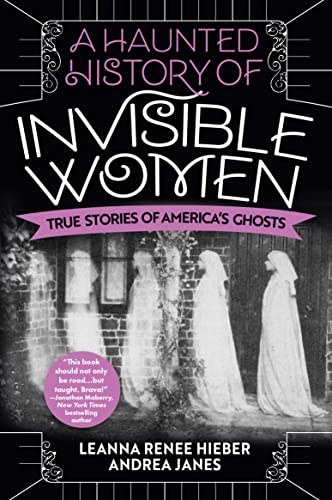
I am somewhat torn about this book. There were some things to love about it and some things to hate as well.
Being someone who is intrigued by the spiritual and historical and having read/enjoyed some of Leanna’s fiction work, the premise and authors of this book intrigued me and led me to want to read it.
Quite a number of the ghost tales were known to me—in fact, one of them was very well known as I spent a semester at Huntingdon College in Montgomery, Alabama in high school in a program called Step Ahead where incoming high school seniors could take two classes (for credit) in the summer. I was pleased that one of the first tales told in this book was about the red lady from there. That summer I lived on campus, we used to walk down to the dorm (Pratt Hall) where the poor girl supposedly died and talk about how tragic that was. A few times, it seemed there was a face at one of the windows on the top floor. Perhaps a flight of fancy since we were told the room had been boarded up. Nevertheless, it was nice to see the story in this book.
Clearly, the authors did a wonderful job fully researching the various stories they chose to share. The way the tales were sorted into categories made sense and the organization was well done. The book had a nice flow to it and a good variety of stories.
Some of the prose was a bit too woke and strident for me. There were also some places that it seemed as if the authors were lecturing or looking down on the reader. It was odd to me for them to basically attempt to shame the very demographic of people who would be attracted to reading the subject matter of this book. It was also strange since one of the authors owns a ghost tour company and the other one leads ghost tours. If you make your living from the industry, how can you legitimately look down on your customers? Seems a bit cynical to me. I almost stopped reading a couple of times because of this, but eventually picked it up again as the actual ghost stories and histories of the places were intriguing.
Overall, I enjoyed this one. I recommend the book for the stories and thorough historical research. Just skim over the parts where the writers’ judgment of the reader is problematic. I’m giving this one 3.5 stars for the historical detail and quality of the tales.
I received a copy of the book from NetGalley in exchange for an unbiased review. September 27, 2022 release date.
The story opens with the hero in dire straits in Iran. He’s in a cell being held at the British embassy and he’s doomed if he doesn’t take action to protect himself.
The hero, Alexsi, warned the British about a plot to kill Churchill ordered by Stalin. As his ‘reward” for doing so, the British intend to send him right back into the fray as a spy for them. A sure fire way for Alexsi to be killed himself.
A clever man who has had a rough existence, he finds a way to survive. But fate has a way of chasing this man and it isn’t long until he’s back in peril. In fact, this whole book is basically him going from one perilous situation to another. Such is the life of a spy in WWII.
Excitement abounds, the story teems with edge of the seat scenarios, and the violence is sometimes stunning and off the charts.
I enjoyed this book for the storyline as well as the hero. He’s smart, industrious, witty and very likeable. Almost like a violent McGyver. He finds his way into scrapes and back out using the resources to hand.
Clearly, the writer of this story has a great way with words and figuring out a way to get his protagonist out of scrapes. I liked the sheer audacity of some of the hero’s actions.
This appears to be book two of a series and it seems there will be a book three since the war isn’t over in the timeline of the story (and even though the ending was satisfying, it is clear this character has more to do). I was pleased to find I didn’t need to have read book one to jump right into book two. There was no confusion about who this man was and why he was in the situation he was in. That being said, I’m planning to go back and read the first one since I’m intrigued by the character. And I eagerly await the next installment.
I would warn readers that the book is quite violent so if you’re squeamish, be wary. Otherwise, be ready for an interesting ride-along with Alexsi.
I received this book from Net Galley in exchange for an unbiased review. It comes out November 15, 2022.
This was a quick read that was enjoyable. I found it interesting that the main character was inspired by a real person. I knew the family who owned the Magnolia Palace were real –The Frick family. Mr. Henry Clay Frick was an industrialist as well as an art patron and eventually, he left his home to the city to make into a museum. Audrey Munson was the woman who inspired the heroine, Lillian, in this story. Audrey was used by many sculptors of that era as a model for many of the statues around the city of New York. Many call her the first super model.
The novel begins with Lillian being in the wrong place at the wrong time and she is questioned in the murder of her landlord’s wife. She flees and ends up in a job interview to be the assistant to Mr. Frick’s daughter.
The action swings back and forth from the gilded age to the 1960s where we meet a model named Veronica who has come over from England to be part of a photo shoot at the Frick mansion which is now a museum. She meets a young man who is interning at the museum. They accidently get locked into the museum overnight in a snowstorm and blackout.
Back in the gilded age, Lillian works for the daughter of the industrialist and tries to help her in her love life as the woman’s father wants her to marry. There’s a lot of interesting psychological undertones in Frick’s son and daughter’s interactions with him as well as each other.
Lillian finds herself falling for the young man who has been chosen to be her employer’s fiancé and he falls for her as well. The daughter goes out of town with her family and sets a kind of treasure hunt around the house for her intended husband in order to amuse him while she’s gone. Lillian helps him in the quest and they draw closer together.
In the 1960s, Veronica finds the clues for the treasure hunt in the house/museum and she, along with the intern start to follow them while they are stranded in the house.
The rest of the story continues to move back and forth between the time periods and the two heroines. A murder occurs and the excitement builds in each era. I won’t say much more as I don’t want to give away any spoilers, but it’s a unique and interesting story. I thoroughly enjoyed it and recommend it if you like art, the gilded age, the 1960s, mysteries and a fictionalized look at the past in an exciting way.
Issues of racism and prejudice against women with ambition are two of the themes of this story as well as family love and conflict. Overall, I think it’s a good story.







 Ramblings of a Writer